
Google Cloud's London Outage: Why Zone Redundancy Doesn't Eliminate the Operational Gap
How Google Cloud's London outage revealed cross-zone cascades, and why infrastructure redundancy cannot bridge the operational gap for client applications.
In this article
- How a single availability zone power event cascaded across regional cloud dependencies in London.
- Why multi-region and multi-AZ backend redundancy does not automatically insulate client applications.
- The architectural distinction between infrastructure health monitoring and machine-readable operational state.
- How an out-of-band operational state control plane coordinates decentralized, capability-level degradation.
- Concrete architectural criteria for determining whether an application estate requires decoupled operational state.
The Bottom Line: Google's October 2026 London outage showed how a power disruption in one availability zone can affect services across a wider regional footprint. Google reported that failover traffic, capacity pressure, and cross-zone dependencies contributed to elevated errors and processing delays in surviving infrastructure.
For application architects, the lesson extends beyond infrastructure redundancy. A successful infrastructure recovery does not guarantee that every dependent client interaction will succeed or that applications will respond gracefully while a dependency is impaired. An Operational State Control Plane can provide a separate mechanism for declaring and distributing capability-level operational conditions, allowing connected applications to apply locally defined fallback behavior without introducing a synchronous control-plane dependency into each user interaction. The effectiveness of this pattern depends on the independence of the distribution path, state freshness, and the application's own resilience policies.
On October 20, 2026, a power disruption at the facility hosting Google Cloud's europe-west2-b availability zone contributed to an outage affecting services across the wider London region. Public reports described disruption to financial services and other customer-facing platforms. The incident provides a useful context for examining how applications behave when infrastructure failover does not immediately restore every dependent service.
The incident illustrates an important architectural risk: infrastructure failover and application-level resilience are separate concerns. Google Cloud's regional recovery mechanisms addressed the infrastructure disruption, but applications that depend on affected services could still experience timeouts, failed transactions, and interrupted user journeys.
A further question for application architects is how their own clients respond when a dependency is impaired. Do they continue submitting requests, retry without sufficient coordination, or adapt the affected capability according to a declared operational condition? The incident does not establish which of these behaviors occurred across affected applications, but it provides a concrete context for examining the design choices.
What Happened in Google Cloud's London Region (europe-west2) Outage?
According to the official Google Cloud Service Health Incident Report, the disruption unfolded across clearly demarcated stages:
- 06:53 BST (05:53 UTC): An electrical power disruption occurred at the third-party datacenter facility housing availability zone
europe-west2-b. Backup systems initiated their transition sequence, but automation faults prevented on-site emergency diesel generators from assuming the load. - Around 07:00 BST (06:00 UTC): Uninterruptible Power Supply (UPS) battery reserves were depleted, causing the zone's infrastructure to lose power. Google designated 07:00 BST as the official incident start time.
- 13:10 BST (12:10 UTC): Google confirmed that service availability had recovered for the vast majority of customer workloads, concluding the core 6-hour, 10-minute incident window.
- 15:03 BST (14:03 UTC): Google posted its final closure update after recovering remaining isolated workloads.
Power issues in datacenters represent a known operational vulnerability. In Uptime Institute's 2025 research, power was the primary cause of 45% of respondents' most recent impactful data-center incidents. In separate research on power-related IT-service outages, respondents most commonly identified UPS failures (42%), transfer-switch failures (36%), and generator failures (28%). These are survey-reported causes, not universal failure probabilities. For more details, consult the Uptime Institute Data Center Outage Report.
Google's report documented that while the physical power event was confined to europe-west2-b, customer workloads in unimpacted zones (europe-west2-a and europe-west2-c) also experienced degradation. Google attributed this regional spillover to two primary factors:
- Surging Compute Demand: Immediate demand surges on unimpacted compute capacity as workloads shifted out of the offline zone.
- Synchronous Control-Plane Dependencies: Cross-zone control-plane API timeouts waiting on validations from components in the offline zone.
Affected managed products included BigQuery, Looker, Google Compute Engine, Google Kubernetes Engine (GKE), Regional Persistent Disk, and Cloud SQL.
What is a Cross-Zone Failure Cascade?
A cross-zone failure cascade occurs when the loss or impairment of one availability zone creates additional load or dependency failures in surviving zones. If those zones cannot absorb redirected workloads or satisfy cross-zone dependencies, the initial disruption can spread beyond the original failure domain. The mechanisms vary by architecture and may include capacity saturation, synchronous dependency timeouts, connection-pool contention, or stateful-service recovery delays.
Figure 1: Illustrative cross-zone failure cascade (an architectural model of dependency coupling, not an exact reconstruction of internal cloud provider topology).
Why Multi-Zone Redundancy Does Not Automatically Protect Client Experience
Deploying workloads across multiple availability zones is essential for backend resilience. However, architects must distinguish between infrastructure recovery and the client experience during failover transitions.
1. Database Failover Intervals
High-availability managed relational databases provide automated failover, but the process is not instantaneous. According to official Google Cloud SQL documentation, an automated failover typically entails approximately 60 seconds of unavailability while heartbeat loss is confirmed and the standby instance is activated. During this transition, existing connections to the primary instance are closed.
Actual failover duration varies based on the database engine, workload volume, replication lag, and network topology. Cloud Spanner and distributed key-value stores use consensus protocols that rebalance differently than traditional primary-standby relational models.
Regardless of the underlying storage engine, a successful backend failover does not guarantee that every client interaction initiated during the transition succeeds. If client applications have no awareness that storage failover is in progress, write transactions submitted during that window may fail, time out, or require application-level reconciliation, depending on the request and connection behavior.
2. Connection Pool Reconnection Dynamics
When an upstream dependency becomes unreachable, active client connections may drop immediately or block until network timeouts expire. Connection pools in application backends then accumulate waiting threads.
Once standby replicas are promoted, hundreds or thousands of application instances may reconnect simultaneously. This reconnection surge introduces connection pool contention and TLS handshake overhead on recovering services. The duration and severity of this effect depend on driver configuration, pool sizing, and retry backoff strategies.
3. Client Retry Amplification
When an application encounters timeouts or HTTP 504 errors, uncoordinated client-side retries can compound backend load. If client applications retry requests aggressively without jitter, backoff, or capability-level awareness, they add avoidable request volume to infrastructure that is already attempting to rebalance.
This dynamic is an established risk in distributed systems. We analyzed similar compounding behaviors in our retrospective on the Azure ingress gateway failure, where uncoordinated retries multiplied pressure during gateway management stalls.
What is the Operational Gap in Cloud Disaster Recovery?
The systemic challenge during regional cloud incidents is rarely a total lack of monitoring. Observability platforms (such as Datadog or OpenTelemetry) alert infrastructure engineers within moments of service degradation. Incident response systems page responders and initiate war rooms.
Yet backend alerts do not automatically translate into coordinated application behavior.
What is the Operational Gap?
The operational gap is the architectural divide between detecting an operational event and making that event available as shared, machine-readable Operational State to the applications affected by it. For a foundational exploration of this divide, see The Operational Gap: Why Upstream Outages Create Fragmented Client Experiences.
Public reporting during the London incident documented widespread consumer and business disruption:
- Financial services provider Revolut reported disruption across card payments, ATM access, and app logins, while confirming customer funds remained safe.
- Retail banks including Lloyds Banking Group and HSBC reported customer access and transaction difficulties.
- The UK HM Courts & Tribunals Service reported service degradation on its Cloud Video Platform across England and Wales.
The societal reach of the outage prompted the Chair of the UK Parliament Treasury Committee to publish a letter to the Bank of England and the Financial Conduct Authority with questions regarding the resilience of critical cloud dependencies under the UK's Critical Third Parties regime.
These public reports demonstrate the scale of the disruption, though they do not disclose the internal architecture of each affected organization. However, engineering teams facing similar outages encounter familiar coordination obstacles:
- Shared Fate in Deployment Pipelines: If deployment tools, administrative consoles, or their dependencies share the affected failure domain, emergency code or UI changes may be delayed precisely when they are needed.
- Shared Failure Domains in Remote Config: If dynamic configuration tools share network paths or cloud regions with failing workloads, updating feature flags during the event may be delayed.
- Status Pages Lack Runtime Governance: External status pages communicate with human users, but they do not inherently provide machine-readable directives that client applications can use to adapt specific workflows. For a detailed comparison, see our analysis of status pages versus operational state control planes.
What is Operational State and How Does It Differ from Application Code?
Addressing the operational gap requires separating the lifecycle of Application Code from the lifecycle of Operational State.
Application Code: How software executes logic.
Deployed via CI/CD pipelines, automated testing, and container registries.
Lifecycle measured in days or weeks.

Feature Flags: Which users or cohorts receive a code path or configuration.
Evaluated against user attributes (user_id, cohort, geography).
Designed for progressive release and experimentation.

Operational State: The operational condition of a capability during an operational event.
Evaluated against system capability health (banking.transfers, orders.checkout).
Distributed to coordinate application adaptation during incidents.
What is Machine-Readable Operational State?
Machine-readable operational state is a structured, versioned payload distributed out-of-band that explicitly communicates the operational posture, degradation severity, and fallback policies for specific application capabilities without requiring code modifications or pipeline execution.
While feature flags typically control which users or cohorts receive a code path or configuration, incident coordination requires capability targeting rather than feature delivery. Operational State communicates the condition of a capability during an operational event, such as declaring that transfers.domestic is degraded. Consuming applications then independently apply local application policy to determine how to adjust their UI and execution logic.
How Does an Out-of-Band Control Plane Isolate Incident Coordination?
When an application's primary cloud infrastructure experiences disruption, using that same infrastructure to coordinate client responses introduces shared fate.
To improve resilience, an Operational State Control Plane operates out-of-band from primary application infrastructure, distributing state via decoupled edge networks.
What is an Operational State Control Plane?
An operational state control plane is a centralized architectural layer for declaring, resolving, and distributing Operational State across connected applications and capabilities during outages, degraded service, and maintenance events. It is designed to operate independently of application deployment pipelines and outside the critical request path.
An out-of-band control plane operates across four stages:
- Declaration: Operators declare system conditions directly or initiate verified incident runbook workflows.
- Deterministic State Resolution: The state engine resolves operational declarations into an effective Operational State for each capability. Different client applications can respond differently according to their design.
- Distribution: Resolved state payloads are written to an independent distribution layer to reduce regional fate-sharing.
- Synchronous SDK Evaluation: Client SDKs synchronize state asynchronously and evaluate it from local memory during application interactions.
1. Request Path Decoupling
The control plane does not sit in the primary request path. User transactions, database queries, and API calls never route through the control plane.
Instead, client runtimes synchronize small static JSON snapshots asynchronously from distributed edge caches into local memory.
2. Synchronous In-Memory Lookups
Because operational state is stored in local memory, application components check capability health synchronously through local in-memory evaluation. Evaluating capability status executes via local memory reads, avoiding synchronous network hops during critical user actions.
3. Risk-Appropriate Fallback Defaults
When network connectivity fails or state distribution is unreachable, an application must apply a defined fallback policy. Continuing normal operation (failing open) can be appropriate for low-risk features, but high-impact transactional capabilities often require a conservative posture. The fallback policy is an application-level governance decision, not a universal guarantee.
How Can Client Applications Execute Decentralized Graceful Degradation?
During a database failover or regional service slowdown, applications that lack operational state may allow users to fill out complex multi-step forms, only to fail on submission.
Applications designed for graceful degradation isolate impacted capabilities at point-of-need boundaries, maintaining availability for unaffected features while offering clear choices on degraded paths.
1. Point-of-Need Capability Boundaries
Rather than displaying a blunt, whole-site maintenance screen, resilient applications isolate impairment to specific capabilities. If transactional database writes are delayed, transfers.domestic can enter a degraded state while account balances, transaction history, and card controls remain fully accessible.
| Uncoordinated Failure Mode | Capability-Aware Degradation |
|---|---|
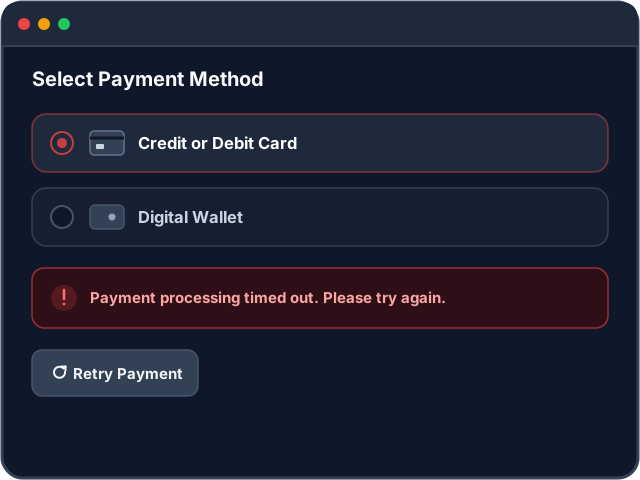 | 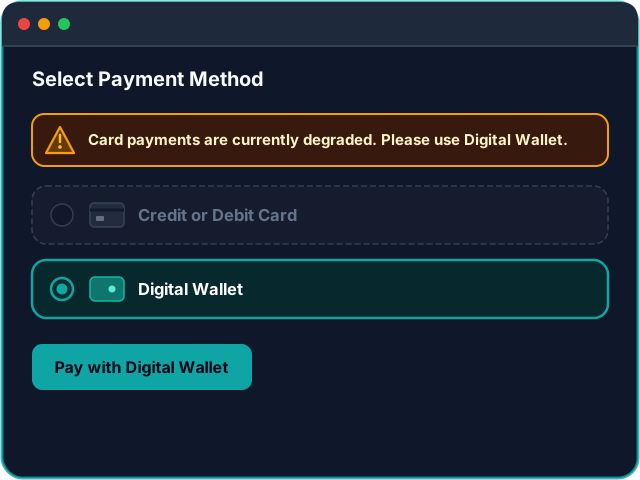 |
| A client application lacks operational awareness, allowing payment submission against an impaired backend dependency. The user encounters a generic timeout error and retries, compounding request load on recovering services. | The client runtime evaluates operational state locally, displaying an inline advisory at the point of need. The degraded card payment rail is paused, guiding the user to an operational alternative without submitting failing requests. |
2. Resolved Operational State Payload
The control plane distributes a structured JSON payload to edge caches. Below is an illustrative payload representing operational states during a regional degradation:
{
  "tenant_id": "tenant_uk_retail_banking",
  "state_version": "2026-10-20T07:15:32.108Z",
  "capabilities": {
    "transfers.domestic": {
      "status": "DEGRADED",
      "policy": {
        "allow_immediate_execution": false,
        "allow_draft_saving": true,
        "customer_advisory": "Payment processing is experiencing delays due to cloud infrastructure maintenance. You can save your transfer as a draft or retry once services normalize."
      }
    },
    "transfers.international": {
      "status": "OUTAGE",
      "policy": {
        "allow_immediate_execution": false,
        "allow_draft_saving": false,
        "customer_advisory": "Cross-border payment rails are temporarily unavailable. Please retry later."
      }
    },
    "accounts.overview": {
      "status": "OPERATIONAL",
      "policy": {
        "allow_cached_reads": true
      }
    }
  }
}
3. Client Implementation: Safe Form Adaptation and Draft Preservation
In client applications, components wrap transactional flows with capability guards using the RuntimeHQ React SDK.
The following React example demonstrates how an application can adapt its UI during degraded conditions. Instead of promising that a financial transfer has been queued for automatic execution, it preserves the entered form data and lets the user save a draft.
The example delegates draft persistence to onSaveTransferDraft. The durability, storage location, and authorization of the draft depend on that implementation. Saving a draft does not constitute submitting or accepting a transfer instruction.
import React, { useState } from "react";
import { useCapability } from "@theruntimehq/react";

interface TransferFormProps {
  onExecuteTransfer: (amount: number, recipient: string) => Promise<void>;
  onSaveTransferDraft: (amount: number, recipient: string) => Promise<void>;
}

export function DomesticTransferCard({
  onExecuteTransfer,
  onSaveTransferDraft,
}: TransferFormProps) {
  const [amount, setAmount] = useState<number>(0);
  const [recipient, setRecipient] = useState<string>("");
  const [isSubmitting, setIsSubmitting] = useState<boolean>(false);
  const [statusFeedback, setStatusFeedback] = useState<string | null>(null);

  // Synchronous in-memory lookup evaluated locally without remote network calls
  const { isDegraded, isOutage, message } = useCapability("transfers.domestic");

  const handleSubmit = async (e: React.FormEvent) => {
    e.preventDefault();
    if (isOutage) return;

    setIsSubmitting(true);
    setStatusFeedback(null);

    try {
      if (isDegraded) {
        // Safe degraded handling: preserve user data as a local draft rather than promising execution
        await onSaveTransferDraft(amount, recipient);
        setStatusFeedback("Transfer details saved as draft. Review and submit once systems recover.");
      } else {
        // Peacetime: standard immediate transaction submission
        await onExecuteTransfer(amount, recipient);
        setStatusFeedback("Transfer submitted successfully.");
      }
    } catch (err) {
      setStatusFeedback("We couldn't confirm the outcome. Check your transfer activity before attempting the transaction again.");
    } finally {
      setIsSubmitting(false);
    }
  };

  if (isOutage) {
    return (
      <div className="p-6 border border-slate-700 bg-slate-900 rounded-lg">
        <h3 className="text-lg font-semibold text-slate-100">Transfers Temporarily Unavailable</h3>
        <p className="mt-2 text-sm text-slate-400">
          {message || "Payment services are currently undergoing maintenance. Transfers are temporarily paused."}
        </p>
      </div>
    );
  }

  return (
    <form onSubmit={handleSubmit} className="p-6 border border-slate-700 bg-slate-900 rounded-lg">
      <h3 className="text-lg font-semibold text-slate-100">Send Domestic Transfer</h3>

      {isDegraded && (
        <div className="mt-3 p-3 bg-amber-950/40 border border-amber-600/50 rounded text-sm text-amber-200">
          <p className="font-medium">Notice: Processing Delays Active</p>
          <p className="mt-1 text-xs text-amber-300/80">
            {message || "Immediate submission is paused. You can save your transfer details as a draft."}
          </p>
        </div>
      )}

      {statusFeedback && (
        <div className="mt-3 p-2 bg-slate-800 rounded text-xs text-slate-300">
          {statusFeedback}
        </div>
      )}

      <div className="mt-4 space-y-4">
        <input
          type="text"
          placeholder="Recipient Sort Code & Account"
          value={recipient}
          onChange={(e) => setRecipient(e.target.value)}
          className="w-full px-3 py-2 bg-slate-800 border border-slate-700 rounded text-slate-200"
          required
        />
        <input
          type="number"
          placeholder="Amount (£)"
          value={amount || ""}
          onChange={(e) => setAmount(Number(e.target.value))}
          className="w-full px-3 py-2 bg-slate-800 border border-slate-700 rounded text-slate-200"
          required
        />
        <button
          type="submit"
          disabled={isSubmitting}
          className={`w-full py-2 px-4 rounded font-medium transition-colors ${
            isDegraded
              ? "bg-amber-600 hover:bg-amber-500 text-slate-950"
              : "bg-teal-600 hover:bg-teal-500 text-white"
          }`}
        >
          {isSubmitting
            ? "Processing..."
            : isDegraded
            ? "Save Transfer Draft"
            : "Send Payment Now"}
        </button>
      </div>
    </form>
  );
}
This pattern provides three key architectural protections:
- Calm Customer Experience: Users receive clear guidance before submitting forms, avoiding unexpected 500 error toasts.
- Controlled Component Load: Preventing new transfer submissions from this component can reduce avoidable request load. Coordinating retries across the wider application and enforcing transaction safety require separate client and server-side policies.
- Server Authority: Preserving form state locally respects user effort while keeping transaction authorization and execution strictly on the server.
Illustrative Failure Modes and Operational-State Responses
The scenarios below are architectural examples, not a reconstruction of the behavior of affected customer applications during the October 2026 incident. The appropriate state and mitigation policy depend on each application's dependencies and safety requirements.
| Failure Scenario | Infrastructure Condition | Potential Uncoordinated Client Risk | Operational State Declaration | Illustrative Client Runtime Adaptation | Policy Governance Model |
|---|---|---|---|---|---|
| Zonal Power Loss | Localized compute and storage impairment; traffic shifts across zones. | Client connections drop; repeated immediate retries add load to surviving zones. | Write capabilities marked DEGRADED; read capabilities remain OPERATIONAL. | Application preserves form data as local drafts and serves cached read models. | Incident commander declaration via out-of-band console. |
| Stateful Database Failover | Managed database promotes standby replica; connections close during failover. | Users encounter timeouts and repeatedly press submit, stacking request queues. | Transactional capabilities marked OUTAGE or DEGRADED. | Client pauses new submissions and informs users that processing will resume shortly. | Runbook-governed declaration based on operational thresholds. |
| API Ingress Saturation | Regional ingress proxies experience queue contention and elevated response latency. | Aggressive retries increase request volume against an already congested API. | Mark affected capabilities DEGRADED and communicate the appropriate request policy. | Reduce or suppress new requests where appropriate; apply bounded exponential backoff with jitter to eligible retries. | Declare the operational condition centrally; enforce request and retry policies in the relevant client and service components. |
| Regional Pipeline Impairment | Build runners and deployment configurations in affected region become unreachable. | Teams cannot deploy hotfix code or modify frontend error templates. | State declarations authored out-of-band via external console or API. | Client runtimes receive updated operational posture via edge caches without code deployment. | Incident response team utilizing independent control plane. |
Core Architectural Principles for Cloud Incident Resilience
Resilience in distributed applications requires five foundational design principles:
- Decouple Operational State Distribution from Workload Infrastructure: Do not rely on the infrastructure currently suffering an outage to distribute the news that it is degraded. Incident coordination should minimize shared failure domains with the workloads it governs.
- Centralize Operational Intent; Decentralize Application Behavior: Declare authoritative operational posture centrally, while allowing each consuming client (iOS, Android, React Web) to determine its appropriate presentation and fallback logic.
- Evaluate Operational State Synchronously from Local Memory: Remove synchronous runtime network calls from user interactions by synchronizing state asynchronously and evaluating it in local memory.
- Degrade at Capability Boundaries, Not Application Boundaries: Isolate degraded backend dependencies to specific functional capabilities (
transfers,analytics) rather than taking down entire application sessions. - Define Risk-Appropriate Fallbacks: Ensure that control-plane or network failures do not block application evaluation, while defining fallback behavior according to each capability's risk. Continuing normal operation may be appropriate for low-risk features; high-impact transactions may require a more conservative policy when the latest state cannot be established.
RuntimeHQ was designed around these principles.
When Do You Need an Out-of-Band Operational State Architecture?
Adopting an Operational State Control Plane provides clear value for organizations with specific operational profiles:
- Multi-Surface Application Estates: You maintain multiple client surfaces (native mobile, single-page web applications, public APIs) that must present consistent operational postures during cloud disruptions.
- High-Impact Workflows: Your application processes financial transfers, checkouts, health records, or travel bookings, where cryptic 500 errors erode trust, create support ticket floods, or trigger regulatory scrutiny.
- Stateful Cloud Dependencies: Your architecture relies on managed cloud databases that incur failover transition windows during zone disruptions.
- Deployment-Independent Response Needs: Your incident response teams need to coordinate customer-facing degradation without deploying emergency frontend code hotfixes or relying on regional CI/CD pipelines.
When This Pattern Adds Unnecessary Complexity
An out-of-band operational state control plane is specialized architecture and is not required for every application:
- Monolithic Server-Rendered Applications: If your architecture is a single server-rendered application with no independent client runtimes, standard reverse-proxy error pages provide sufficient resilience.
- Asynchronous Batch Processing: Systems dominated by background message queues where operations can pause safely in persistent storage without direct user interaction do not require client-side state coordination.
- Early-Stage MVPs: Applications with low traffic volumes and single interfaces where occasional errors during cloud outages carry minimal business impact.
Conclusion: When Do You Need an Operational State Control Plane?
Google Cloud's October 2026 London outage demonstrated that physical datacenter disruptions, electromechanical transfer failures, and cross-zone cascades remain unavoidable realities of distributed computing. Datacenters will experience power loss, and stateful services will require time to recover.
Multi-region infrastructure and database replication can improve availability and support recovery, while circuit breakers help limit failure propagation between dependent services. These mechanisms address different failure modes, and none guarantees that every client interaction will succeed during a disruption. Infrastructure recovery alone does not guarantee that client applications will adapt gracefully while dependencies are impaired.
An Operational State Control Plane provides a dedicated mechanism for declaring, resolving, and distributing machine-readable operational conditions out-of-band. By decoupling operational-state distribution from primary application infrastructure, teams can coordinate declared operational conditions across connected applications while allowing each runtime to apply its local fallback policy. The effectiveness of this approach depends on distribution-path independence, synchronization, and application-level enforcement.
If your team is evaluating your application estate's resilience during regional cloud disruptions, connect with RuntimeHQ to review your operational state architecture.
Book a Walkthrough
Discuss your architecture and integration directly with the engineers building RuntimeHQ. No sales reps or qualification decks.
Pick a Time