
LaunchDarkly vs. RuntimeHQ: Feature and Operational Control
Compare LaunchDarkly vs RuntimeHQ: why feature delivery platforms and operational state control planes solve different distributed systems problems.
In this article
- The structural architectural boundaries separating progressive software delivery from live operational state coordination.
- How LaunchDarkly permanent kill switches operate, and where binary shutoffs reach limits during graduated capability degradation.
- Why managing incident communications through independent feature flags introduces schema drift and lacks deterministic precedence policies across overlapping incidents.
- When standard LaunchDarkly release flags and kill switches are architecturally sufficient, and the specific operational threshold that warrants decoupling operational state.
- How client and backend runtimes consume out-of-band operational state to execute point-of-need degradation without synchronous request-path dependencies.
The Bottom Line: Feature flag platforms like LaunchDarkly are purpose-built to control feature exposure based on user context and progressive release rules, whereas an Operational State Control Plane governs how applications degrade during live dependency outages and maintenance windows. While LaunchDarkly provides permanent kill switch templates, JSON flag variations, and automated triggers, representing operational states across independent flags requires engineering teams to build and maintain custom reconciliation logic, schema contracts, and localized messaging. Decoupling operational state into a dedicated control plane allows teams to preserve LaunchDarkly for feature delivery and experimentation while resolving concurrent conditions into a single effective operational state that connected applications can use to guide runtime behavior outside the critical request path.
During a high-severity production incident, reaching for your existing feature flag platform feels like the most pragmatic operational move. The SDK is already initialized across your web, mobile, and backend codebases, and flipping an emergency kill switch can be executed without deploying code.
As organizations grow beyond a single web application, teams discover that feature toggles built to answer "who should see this feature?" struggle to coordinate "how should our applications behave right now while an upstream dependency is failing?"
Understanding why this friction emerges requires examining how feature management and operational control differ at the system boundary.
Why Do Engineering Teams Reach for LaunchDarkly During Incidents?
LaunchDarkly is a widely used feature management platform for progressive software delivery, trunk-based development, and multivariate experimentation. When an upstream database, third-party payment gateway, or search cluster experiences latency spikes or service degradation, incident responders look for operational levers that do not require an emergency code deployment.
Standard deployment pipelines, including code review, automated testing, container builds, and canary verification, introduce necessary safety checks that are fundamentally too slow when an upstream dependency is actively failing in production. Because runtime toggles bypass deployment pipelines, teams naturally reach for existing flag infrastructure to alter application behavior immediately.
Because LaunchDarkly SDKs are already embedded across client and server architectures, engineering teams turn to them during Sev-1 bridge calls. The platform provides battle-tested infrastructure, local in-memory SDK evaluation, streaming updates, and enterprise-grade reliability.
Within LaunchDarkly, two native capabilities specifically support operational emergencies:
- Permanent Kill Switches (Emergency Shutoffs): As documented in LaunchDarkly's kill-switch documentation, teams can configure permanent boolean flags designed to shut off non-core functionality or failing third-party integrations. These flags bypass complex user targeting rules, conventionally serving "Enabled" (
true) by default when active and "Disabled" (false) when toggled off. While often colloquially referred to as circuit breakers, a kill switch is an administrative or automated toggle that disables a code path, whereas a traditional circuit breaker is a stateful networking mechanism that tracks failure rates and trips open dynamically. - Flag Triggers: LaunchDarkly supports automated triggers that connect to Application Performance Monitoring (APM) tools such as Datadog, Dynatrace, and New Relic. When an alert detects elevated error rates or p99 latency spikes, it can send an automated webhook to toggle a kill switch without human intervention.
These capabilities work well for isolating an experimental feature or turning off a failing non-critical code path. However, when an operational event demands graduated degradation, coordinated customer communication, or multi-incident resolution across multiple client surfaces, using delivery toggles as an operational control plane reveals fundamental domain mismatches.
What is Feature Management?
Feature Management is an engineering discipline and software delivery pattern that enables teams to safely release, control, and experiment on application code paths at runtime. It relies on conditional logic evaluated against user context (such as user identity, tenancy, environment, or percentage cohorts) to govern progressive rollouts, canary deployments, and targeted feature exposure without redeploying code.
Why Do Binary Kill Switches Struggle with Incident Degradation?
A binary kill switch answers a single boolean question: should this specific block of code execute or be bypassed? During production incidents, engineering requirements are rarely binary. This domain friction explains why outage banners and incident degradation do not belong in feature flags.
1. Binary Shutoff vs. Graduated Capability Degradation
LaunchDarkly permanent kill switch templates conventionally operate as binary toggles (Enabled or Disabled). Flipping a kill switch severs a code path completely.
Real-world production incidents, however, typically demand graduated capability degradation:
- If a primary card payment processor suffers elevated latency, the system should not disable the entire checkout flow.
- The application should switch card transactions to asynchronous queueing with a longer debounce, display an informative point-of-need advisory notice, and prominently offer alternative payment methods such as PayPal or wire transfers.
- Core checkout workflows remain operational while only the degraded capability is adapted.
A binary kill switch forces an all-or-nothing trade-off. Responders must either leave a failing integration exposed to user frustration, or disable the entire user workflow, turning a partial dependency slowdown into a self-inflicted total outage. While teams can construct multi-state configurations using JSON flags, doing so shifts the responsibility of state modeling and lifecycle management to custom application code.
2. The Targeting Dimension Mismatch: User Context vs. Capability State
Feature flags evaluate rules against evaluation contexts containing attributes like user.id, tenant.tier, country, and device.os. LaunchDarkly contexts can model entities beyond individual users, but flags remain fundamentally oriented around context-based rule evaluation.
Operational incidents, in contrast, affect system capabilities (such as payments.card_tokenization, search.autocomplete, or reports.export) regardless of user identity. While teams can configure flags with global targeting rules or default variations to represent system conditions, feature flags do not natively model the relationship between an operational incident, the affected capabilities, and the required application degradation behavior. Understanding why user and entity targeting differs from capability-scoped operational state is the premise behind capability targeting versus feature delivery.
The fundamental difference lies in the input entity and evaluation domain:
What is an Application Capability?
An Application Capability is a discrete, customer-facing functional unit of an application system (such as Card Tokenization, Flight Seat Selection, or Invoice PDF Generation) that relies on specific internal services or third-party dependencies. Capabilities represent the granular boundaries at which applications can adapt or degrade during an operational event, distinct from the infrastructure components supporting them.
3. Context Construction Failures and Application Fallback Policies
LaunchDarkly SDKs evaluate flags locally using their cached flag configuration and the context supplied by the host application. They do not need to contact central servers for each evaluation call.
The architectural challenge lies in context construction and fallback policies:
- Context Dependency: Evaluating context-based rules requires the host application to construct an evaluation context. If an incident impairs an upstream identity provider, session store, or token service, an application may struggle to supply the required context attributes.
- Application Fallback Policy: When an SDK cannot evaluate a flag against context or has not completed initialization, it returns an application-configured fallback value.
- The Unsafe Fallback Risk: If the application configures a fail-open fallback (such as defaulting
checkoutEnabledtotrue), sessions that fail context initialization will evaluate the flag totrue, continuing to attempt checkout against an impaired backend. Conversely, defaulting tofalsewould disable checkout for users during transient context glitches. Application-specific context construction and fallback policies thus introduce an additional operational variable during incidents. - Capability Scoping: An operational state model avoids this dependency by evaluating capability conditions directly, decoupling system availability from user session state.
4. Dashboard Clutter, Toggle Hygiene, and Technical Debt
In large engineering organizations, feature management platforms host hundreds of active flags across product management, growth marketing, multivariate experiments, and canary rollouts.
In an empirical study of feature toggle lifecycles published at ACM/IEEE MSR, researchers tracked 2,409 toggles and found that 53% of temporary release toggles in the studied repositories remained in codebases after 10 releases. While toggle hygiene and cleanup practices vary across engineering organizations, managing emergency operational toggles inside an environment populated by hundreds of release flags introduces potential governance and usability risks. During a high-stress Sev-1 bridge call, responders benefit from dedicated operational interfaces, audit trails, and pre-approved messaging, rather than navigating release dashboards shared across general development teams.
Incident response requires strict governance. An Incident Commander or SRE responding to an active outage needs scoped operational controls, audit timelines, and pre-approved messaging templates, not broad product-release permissions shared across development teams.
The Model vs. Storage Gap: Why Is a JSON Payload Not an Operational State Model?
Modern feature flag platforms are not limited to simple booleans. LaunchDarkly natively supports multivariate flags, structured JSON payloads, and optional JSON Schema validation to enforce payload data types and allowed enum values.
This capability often prompts a common architectural proposal: "Why not store a JSON object containing { "status": "degraded", "message": "Down" } inside a LaunchDarkly flag?"
While technically feasible, storing a validated JSON payload in a feature flag provides storage, not an operational-state model. To understand why schema validation differs from a complete operational model, consider the division of responsibilities:
| Operational Concern | What JSON Schema Validation Provides | What Still Requires an Operational Model |
|---|---|---|
| Payload Structure | Validates field names and primitive data types | Defines the operational meaning of fields across polyglot runtimes |
| State Values | Restricts status fields to permitted enum strings | Defines how each operational state alters capability boundaries |
| Lifecycle Transitions | Validates static object schemas | Enforces valid transitions (Scheduled, Active, Investigating, Resolved) |
| Concurrent Incidents | Stores multiple data records in a payload | Resolves overlapping conditions into a single effective operational state |
| Client Interpretation | Ensures payloads conform to syntax rules | Coordinates consistent fallback behavior across web, mobile, and APIs |
When an organization relies on JSON blobs inside feature flags, the engineering team must design, build, and maintain the surrounding operational state engine:
- Polyglot Semantic Interpretation: Web frontends, mobile apps, and backend microservices must interpret identical keys and implement uniform degradation behavior.
- Lifecycle State Management: A flag has no native understanding of incident lifecycles or audit transitions.
- Multi-Surface Communication: Managing customer-facing copy inside arbitrary flag strings lacks localization workflows, review approvals, and consistency across client platforms.
- Client Fallback Logic: Every individual repository must implement custom conditional wrappers to interpret what "degraded" means for its local UI components.
Without a dedicated control plane, teams inadvertently find themselves building an in-house operational state engine on top of generic flag storage, adding custom orchestration code that sits idle between incidents.
How Do Overlapping Incidents Create State Conflicts Across Independent Flags?
LaunchDarkly provides robust single-flag concurrency through optimistic versioning (semantic patch checks), preventing simultaneous conflicting writes to the same flag entity. Furthermore, LaunchDarkly supports static flag prerequisites, allowing Flag A to depend on Flag B.
However, individual flags evaluate against their individual rule trees. Those mechanisms do not automatically constitute a shared operational-state model that resolves concurrent incident conditions into one effective state for an affected capability.
The Overlapping Incident Failure Mode
Consider a single critical capability: billing.checkout. This capability depends on both an internal billing database replica and an external payment gateway.
Now consider two concurrent operational conditions affecting this capability:
- Scheduled Maintenance: The platform team schedules a database replica maintenance window for billing, setting
checkout_db_maintenance = true. The UI displays a planned maintenance advisory. - Unplanned Sev-1 Outage: Twenty minutes later, a network partition disconnects the primary payment gateway. Responders set
checkout_gateway_outage = true, which requires an immediate capability suspension. - Maintenance Window Concludes: The database maintenance finishes on schedule. An automated script or platform engineer marks the maintenance task complete, clearing
checkout_db_maintenance = false.
Independent flags do not automatically produce broken states, but they shift the entire reconciliation burden to the consuming application:
- If a client component checks
checkout_db_maintenancein an initial guard clause, or if a custom reducer evaluates flags in an arbitrary order, clearing the maintenance flag can cause the application to display normal checkout UI while the gateway outage remains active. - To prevent this, every web, mobile, and backend repository must implement and maintain custom multi-flag reconciliation logic that accurately combines all possible combinations of maintenance and incident flags.
LaunchDarkly stores and evaluates the individual flags. The engineering team remains responsible for designing, testing, and maintaining the cross-flag reconciliation policy.
What is Deterministic State Resolution?
Deterministic State Resolution is the operational process of resolving the same set of active incident declarations, scheduled maintenance windows, and administrative overrides into a predictable effective Operational State for a given capability. Rather than treating maintenance and outages as interchangeable points on a single severity scale, an operational state control plane applies explicit precedence rules to concurrent conditions. For example, RuntimeHQ's default resolution policy enforces that an active Outage declaration supersedes concurrent Degraded or Maintenance declarations on that capability until the outage condition is explicitly resolved, while allowing connected applications to tailor their runtime responses to that shared effective state.
What Is an Operational State Control Plane, and How Does It Complement LaunchDarkly?
LaunchDarkly and RuntimeHQ address different stages of the software lifecycle. They are complementary systems designed for distinct operational domains.
LaunchDarkly governs feature delivery and flag-driven runtime behavior: progressive rollouts, feature experimentation, canary cohorts, and release validation based on user context.
RuntimeHQ operates as an Operational State Control Plane (OSCP): coordinating runtime application behavior, capability degradation, and customer-facing communication during operational disruptions.
As documented in LaunchDarkly's SDK architecture, server-side SDKs evaluate flag rules locally in memory from cached data without synchronous network requests. RuntimeHQ follows the same zero-request-path principle, evaluating capability state in local memory. The architectural distinction lies in the domain model: LaunchDarkly resolves user and entity targeting rules, while RuntimeHQ provides an operational model that applies precedence policies across concurrent incident declarations.
The following flowchart illustrates how the two control loops operate in parallel:
Out-of-Band State Distribution
RuntimeHQ distributes operational state through an out-of-band architecture:
- Explicit Operational Declaration: Operators declare an incident or scheduled maintenance via the control plane console, Slack (
/runtimehq), or incident-orchestration webhooks (such as PagerDuty and Incident.io). - State Resolution Engine: The engine evaluates all concurrent declarations and overrides, resolving a single effective capability state artifact (
OPERATIONAL,DEGRADED,OUTAGE, orMAINTENANCE). - Edge Distribution: Resolved state artifacts are distributed globally through edge caching using short cache headers and background revalidation.
- SDK Synchronization: Client and backend SDKs synchronize state asynchronously in the background. Applications evaluate capability state directly from local in-memory state without introducing synchronous external network or control-plane dependencies into the critical request path.
What is an Operational State Control Plane?
An Operational State Control Plane (OSCP) is a centralized architectural layer for declaring, resolving, and distributing machine-readable Operational State across connected applications, services, and client runtimes during outages, degraded performance, and maintenance events. It operates outside the primary request path and independently of application deployment pipelines.
Architectural Comparison: Feature Flag Platforms vs. Operational State Control Planes
To understand where each system fits in an enterprise architecture, compare their core design dimensions:
| Architectural Dimension | Feature Flag Platforms (LaunchDarkly) | Operational State Control Planes (RuntimeHQ) |
|---|---|---|
| Primary Domain & Question | Progressive delivery: "Who should receive this code path or experiment?" | Operational coordination: "How should system capabilities behave during an operational event?" |
| Operational Control Mechanism | Operational flags, permanent kill switches, and structured JSON variations (multi-state behavior managed via custom code) | Native capability lifecycle states (OPERATIONAL, DEGRADED, OUTAGE, MAINTENANCE) |
| Evaluation Entity | User and entity context (user.id, tenant.tier, cohort, environment) | Application Capabilities (payments.tokenization, search.autocomplete, auth.mfa) |
| Data Model & Schema | Generic flags with optional JSON Schema validation | Domain-specific operational state schema with lifecycle transitions and localized copy |
| Concurrency & Precedence | Independent flag evaluation with static prerequisites; cross-flag precedence resolved in application logic | Deterministic precedence policy resolving concurrent incident and maintenance conditions into one effective state |
| Incident Automation | Flag triggers automate targeting changes on individual flags via APM webhooks | Incident declarations integrated with incident command workflows (PagerDuty, Incident.io, Slack) |
| Governance & Scoping | Granular RBAC and custom roles configured across projects, environments, and flag tags | Capability-scoped operational governance tailored for SREs, Incident Commanders, and Platform teams |
How Does Declarative Capability State Look in Application Code?
Comparing code implementations illustrates how these architectural models affect application maintainability.
Approach 1: LaunchDarkly Reactive Flags and Custom JSON Handling
When using a feature management SDK for operational degradation, developers consume flags reactively using SDK hooks while managing multi-state parsing in application logic:
import { useBoolVariation, useJsonVariation } from "@launchdarkly/react-sdk";

export function CheckoutButton({ onCheckout }) {
  // Using LaunchDarkly React SDK v4 (@launchdarkly/react-sdk)
  // Typed variation hooks evaluate flags reactively against current context and subscribe to updates
  const checkoutEnabled = useBoolVariation("checkout-enabled", true);
  const degradedConfig = useJsonVariation("checkout-degraded-config", null);

  // Conventional kill-switch semantics: false indicates the feature is disabled
  if (checkoutEnabled === false) {
    return <div className="notice-error">Checkout is temporarily offline.</div>;
  }

  // Custom multi-state degradation requires parsing application-specific JSON payloads
  if (degradedConfig?.isDegraded) {
    return (
      <div>
        <p className="notice-warning">
          {degradedConfig.noticeText || "Card processing is delayed."}
        </p>
        <button onClick={() => onCheckout({ fallbackMode: true })} className="btn-secondary">
          Pay with Alternative Method
        </button>
      </div>
    );
  }

  return <button onClick={onCheckout} className="btn-primary">Complete Order</button>;
}
In this pattern, the application is responsible for managing schema parsing, handling malformed payloads, and reconciling conflicting flags. If the user context fails to evaluate, checkoutEnabled resolves to its application-configured fallback value (here, true). When configured to fail open, checkout attempts continue reaching the impaired backend during an incident.
Approach 2: Native Capability State via RuntimeHQ SDK
With the RuntimeHQ React SDK (@theruntimehq/react), applications consume typed capability state evaluated directly from local SDK memory:
import { useCapability } from "@theruntimehq/react";

export function CheckoutButton({ onCheckout }) {
  // Evaluated synchronously against local SDK memory without user context dependencies
  const { isDegraded, isOutage, message, loading } =
    useCapability("checkout.payment_processing");

  // In sensitive transactional flows, inspecting loading prevents submitting before initial status check resolves
  if (loading) {
    return (
      <button disabled className="btn-primary opacity-50 cursor-not-allowed">
        Checking status...
      </button>
    );
  }

  // Differentiate OUTAGE behavior (feature suspension) from DEGRADED behavior (advisory and fallbacks)
  if (isOutage) {
    return <div className="notice-error">{message || "Payment processing unavailable."}</div>;
  }

  if (isDegraded) {
    return (
      <div>
        <p className="notice-warning">{message}</p>
        <button onClick={() => onCheckout({ fallbackMode: true })} className="btn-secondary">
          Proceed with Alternative Payment
        </button>
      </div>
    );
  }

  return <button onClick={onCheckout} className="btn-primary">Complete Order</button>;
}
Client UI Gating vs. Authoritative Backend Enforcement
While client UI adaptation improves the user experience by providing proactive guidance, client-side gating does not replace authoritative backend transaction enforcement:
- Client Presentation Guidance: Inspecting
isDegradedorisOutagein the browser can reduce avoidable submissions from that interface, protecting users from doomed form completions. - Backend Transaction Enforcement: Backend services, API gateways, and message queues must independently evaluate capability state to enforce idempotency, reject or queue transactions safely, and protect downstream databases.
- SDK Pre-Sync Defaults: The RuntimeHQ SDK defaults to fail-open (
isOperational: true,isOutage: false,loading: true) during initial cold-start synchronization to avoid blocking UI rendering if network connectivity is interrupted. For high-risk transactional flows, applications can inspectloadingto hold action buttons until the initial status check resolves.
Visual Comparison: Uncoordinated Errors vs. Point-of-Need Serenity
The difference in user experience between reactive error handling and declarative operational state is substantial:
| Uncoordinated Failure (Generic Error Toast) | Point-of-Need Graceful Degradation |
|---|---|
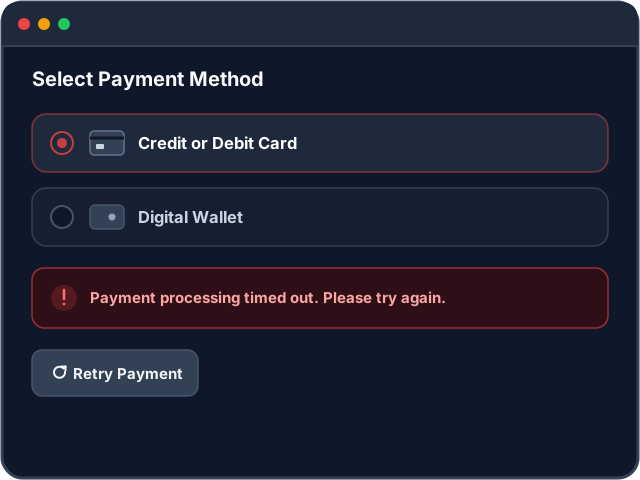 | 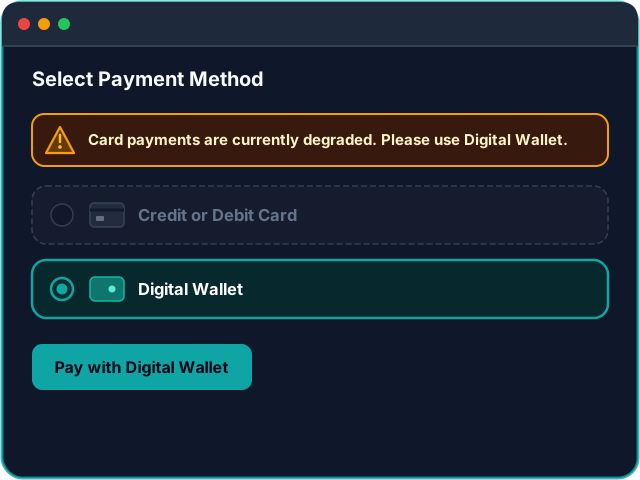 |
When systems fail without operational state coordination, users fill out complex forms only to encounter opaque 500 Internal Server Error toasts upon submission. With capability-scoped degradation, applications proactively adapt the interface, setting accurate expectations and offering viable alternatives before submission.
Where Does This Control Decision Belong?
To maintain clean architectural boundaries, engineering organizations should establish clear criteria for routing decisions between feature delivery, operational control, and code deployments:
| Decision Trigger | Target System | Architectural Rationale |
|---|---|---|
| Canary rollout of a new checkout UI (5% to 100%) | LaunchDarkly | Audience targeting based on user percentage cohorts and experimentation |
| A/B testing two pricing page layouts | LaunchDarkly | Multivariate experimentation evaluated against user and tenant segments |
| Early access beta for enterprise customers | LaunchDarkly | Rule evaluation based on customer account attributes and tenant tiers |
| Emergency shutoff of a broken experimental release | LaunchDarkly | Permanent kill switch isolating a specific, newly deployed code path |
| Upstream payment gateway experiencing latency spikes | RuntimeHQ | System capability degradation independent of user identity or cohort rules |
| Scheduled database maintenance window | RuntimeHQ | Deterministic state override with maintenance timeline and customer notices |
| Disabling heavy PDF export jobs during peak load | RuntimeHQ | Declares and distributes operational condition so applications gracefully defer export processing |
| Permanent deprecation of legacy v1 REST endpoints | Code Deployment | Permanent structural retirement handled via API gateway routing or code lifecycle |
Core Architectural Principles for Decoupling Delivery from Operational Control
When designing distributed systems that must remain resilient during operational disruptions, adhere to these architectural principles:
- Centralize Operational Intent; Decentralize Application Behavior: The control plane coordinates what operational state exists across capabilities; individual client and backend applications own how they adapt their user interfaces and request pipelines.
- Decouple Operational Health from User Context: Incident response targets system capabilities. Coupling capability health to user context creates brittle failure domains when authentication or session systems degrade.
- Explicit Precedence Policies Prevent Inconsistent State: During overlapping operational events, capabilities must resolve through defined precedence rules (such as an emergency Outage taking precedence over planned Maintenance), rather than leaving state reconciliation to independent uncoordinated toggles.
- Isolate the Control Plane from the Request Path: Application runtimes must evaluate state in local memory through asynchronous background synchronization without making synchronous control-plane calls on the critical request path.
RuntimeHQ was designed around these principles.
When Do You Need a Dedicated Operational State Control Plane?
Use this diagnostic checklist to determine whether your architecture warrants decoupling operational state from feature flags:
- Multiple Client Surfaces: You operate two or more distinct user-facing surfaces (such as web, mobile apps, partner APIs, or admin portals) that must coordinate behavior during outages.
- High-Anxiety Transactional Flows: You maintain critical transactional flows (such as checkouts, financial transfers, or appointment scheduling) where generic error toasts cause user panic and support ticket surges.
- Graduated Degradation Requirements: You require graduated graceful degradation (alternative flows, advisory notices, rate throttling) rather than binary code shutoffs.
- Operational Fatigue and Manual Glue: Your incident response runbooks involve manual dashboard toggling across multiple tools or emergency pull requests just to display maintenance banners.
- Multi-Incident Concurrency: You have experienced overlapping incidents or maintenance windows where clearing one emergency toggle accidentally exposed another failing service.
When LaunchDarkly Alone Is Sufficient
A dedicated control plane is not necessary for every system. LaunchDarkly alone is architecturally sufficient when:
- Peacetime Feature Delivery: Your primary objective is progressive rollouts, trunk-based development, and user experimentation. LaunchDarkly is built for this domain.
- Isolated Binary Kill Switches: Your operational requirements are limited to turning an isolated, non-critical feature off without graduated UX or cross-client messaging.
- Application Code Bugs: Neither LaunchDarkly nor RuntimeHQ fixes unhandled runtime exceptions or software syntax defects. Those require automated testing, staging validation, and code hotfixes.
Conclusion: When Do You Need an Operational State Control Plane?
Software delivery and operational resilience solve two distinct problems in distributed systems.
LaunchDarkly provides engineering and product teams with granular control over software delivery lifecycles, enabling progressive rollouts and safe canary releases. Its permanent kill switches and automated triggers offer effective emergency shutoffs for experimental code paths.
When production disruptions require graduated capability degradation, cross-application state synchronization, and predictable reconciliation across overlapping incident declarations, an Operational State Control Plane provides a dedicated domain model and out-of-band distribution that connected applications can use to coordinate graceful degradation.
Decoupling operational state from progressive delivery allows release management and operational resilience workflows to evolve independently, preserving feature experimentation while giving incident responders a reliable foundation for protecting customer trust during production disruptions.
If you are evaluating how to structure operational state management across your distributed applications, discuss your operational-state architecture with our engineering team.
Book a Walkthrough
Discuss your architecture and integration directly with the engineers building RuntimeHQ. No sales reps or qualification decks.
Pick a Time