
Polling vs. SSE for Operational State Distribution
An architectural comparison of background polling and Server-Sent Events (SSE) for operational state distribution across edge networks and client runtimes.
In this article
- Architectural boundaries distinguishing high-frequency event streaming from low-velocity operational state distribution.
- Comparative analysis of Server-Sent Events (SSE) and HTTP background polling across connection statefulness, edge cacheability, and resource overhead.
- Root causes of connection stampedes and gateway throttling during cloud brownouts and mass reconnection waves.
- Implementation of RFC 9110 conditional validation (304 Not Modified) alongside RFC 5861 stale-serving directives to shield origin infrastructure while balancing freshness and resilience.
- Strategies for decoupling operational state distribution from application request paths to achieve local in-memory evaluation without added network latency.
The Bottom Line: Server-Sent Events and WebSockets excel at high-frequency, bidirectional application data streams, but introduce stateful connection overhead and stampede risks when repurposed for operational state distribution. Background HTTP polling backed by edge CDNs, RFC 5861 stale-serving extensions, and RFC 9110 conditional validation decouples origin load from client concurrency, keeping client request paths completely out-of-band while trading bounded propagation latency for wartime resilience.
Choosing between persistent push protocols and background polling often triggers dogmatic debate among systems architects. Streaming protocols feel modern, reactive, and architecturally clean. Polling is frequently dismissed as an archaic relic of early web development that wastes bandwidth and polling cycles.
In distributed systems, protocol elegance remains subordinate to operational domain alignment. When evaluating how to distribute operational state across tens of thousands of client runtimes during production incidents, the right protocol choice depends on read-to-write ratios, caching topology, and how systems behave when the cloud is under severe stress.
Understanding why this boundary matters requires separating continuous application data streams from broadcast operational state distribution.
Why Do Broadcast State and Application Data Streaming Require Different Architectures?
Before comparing protocol mechanics, engineering teams must distinguish between two fundamentally different communication patterns:
- High-Frequency Application Data Streams: Characterized by rapid bidirectional or server-initiated updates where latency matters at the sub-second level. Workloads include collaborative whiteboard cursors, live customer support chat, multiplayer game state, and financial ticker updates. In these domains, persistent push protocols such as WebSockets and Server-Sent Events are widely used and well suited to the workload physics.
- Broadcast Operational State: Characterized by sparse writes and massive read fanout. Operational transitions occur during deployments, cloud provider brownouts, third-party dependency degradations, or scheduled maintenance windows. In contrast, operational state reads occur continuously on every route navigation, user checkout, and API invocation across every active client session.
In operational state coordination, the read-to-write ratio can become extremely asymmetric (for example, tens of thousands of client runtimes repeatedly reading state while operational transitions occur only occasionally). Consuming client runtimes do not need a continuous stream of historical delta events. They need eventual, deterministic convergence on the current authoritative state snapshot.
What is Operational State?
Operational State is machine-readable metadata communicating the health, capability availability, and operational posture of system components during an operational event. Unlike application domain data (such as user profiles, order items, or chat messages), operational state communicates conditions such as OPERATIONAL, DEGRADED, OUTAGE, or MAINTENANCE across system capabilities. It guides how client runtimes, background workers, and API gateways adapt their execution without requiring emergency code deployments.
The following domain matrix outlines the structural differences between these two workloads:
| Engineering Vector | Application Data Streaming (WebSockets / SSE) | Operational State Distribution (Edge-Cached Polling) |
|---|---|---|
| Primary Workload | Live chat, collaborative editing, gaming, trade ticks | Capability health, incident advisories, degradation policies |
| Update Velocity | Hundreds to thousands of updates per second | Infrequent: minutes, hours, or days between transitions |
| Read to Write Ratio | Balanced: roughly 1:1 to 10:1 | Highly asymmetric: large read fanout vs. infrequent transitions |
| Data Shape | Chronological event stream and delta messages | Authoritative resolved state snapshot |
| Reconnection Priority | Replay missed sequential log entries (or fetch fresh snapshot) | Converge on the current state artifact |
| Origin Resource Footprint | O(N) persistent sockets, gateway sessions, and memory buffers | Bounded primarily by cache topology, TTL, and revalidation |
| Network Path | Direct point-to-point stateful socket connection | Decoupled out-of-band CDN distribution layer |
Operational state is fundamentally a snapshot-convergence problem, not an event-streaming problem. When teams repurpose persistent push protocols for broadcast operational state, they inadvertently couple client concurrency directly to origin connection capacity.
How Do Server-Sent Events and HTTP Background Polling Work?
To understand how these workloads behave under load, compare their underlying network mechanics.
Server-Sent Events (SSE) Architecture
Server-Sent Events provide a unidirectional channel where servers push data to clients over standard HTTP (text/event-stream). Browsers consume SSE natively via the EventSource interface, which includes automated reconnection handling and event identification via the Last-Event-ID header.
Because SSE operates over standard HTTP, it avoids the bidirectional framing and protocol upgrade overhead of WebSockets. However, an SSE stream is a long-lived HTTP response whose useful data is generated over time:
- Every connected client maintains an open TCP and TLS session with an origin gateway or managed connection broker.
- Reverse proxies, ingress gateways, and edge brokers must allocate dedicated socket memory, session entries, and file descriptors for each concurrent client.
- Traditional HTTP object caching cannot provide the same fan-out model for an open-ended byte stream as it does for finite, versioned state snapshots.
While reverse proxies, API gateways, or managed event platforms can terminate or proxy SSE streams, each client session still requires stateful connection management and tracking across the gateway layer.
HTTP Background Polling Architecture
HTTP background polling relies on standard, stateless request-response transactions over multiplexed HTTP/2 and HTTP/3 connections. Client SDKs periodically query a resolved state artifact hosted on an edge distribution network.
Because each poll is an independent HTTP transaction:
- Edge Content Delivery Networks (CDNs) cache the resolved state artifact across hundreds of global edge cache Points of Presence (PoPs).
- High cache hit ratios at the edge can absorb the vast majority of client polling requests, shielding origin systems from concurrency surges.
- Propagation latency is bounded by the client polling cadence and the cache freshness and revalidation policy; the exact bound depends on cache tiering, stale-while-revalidate timing, and whether the updated state has reached the serving edge.
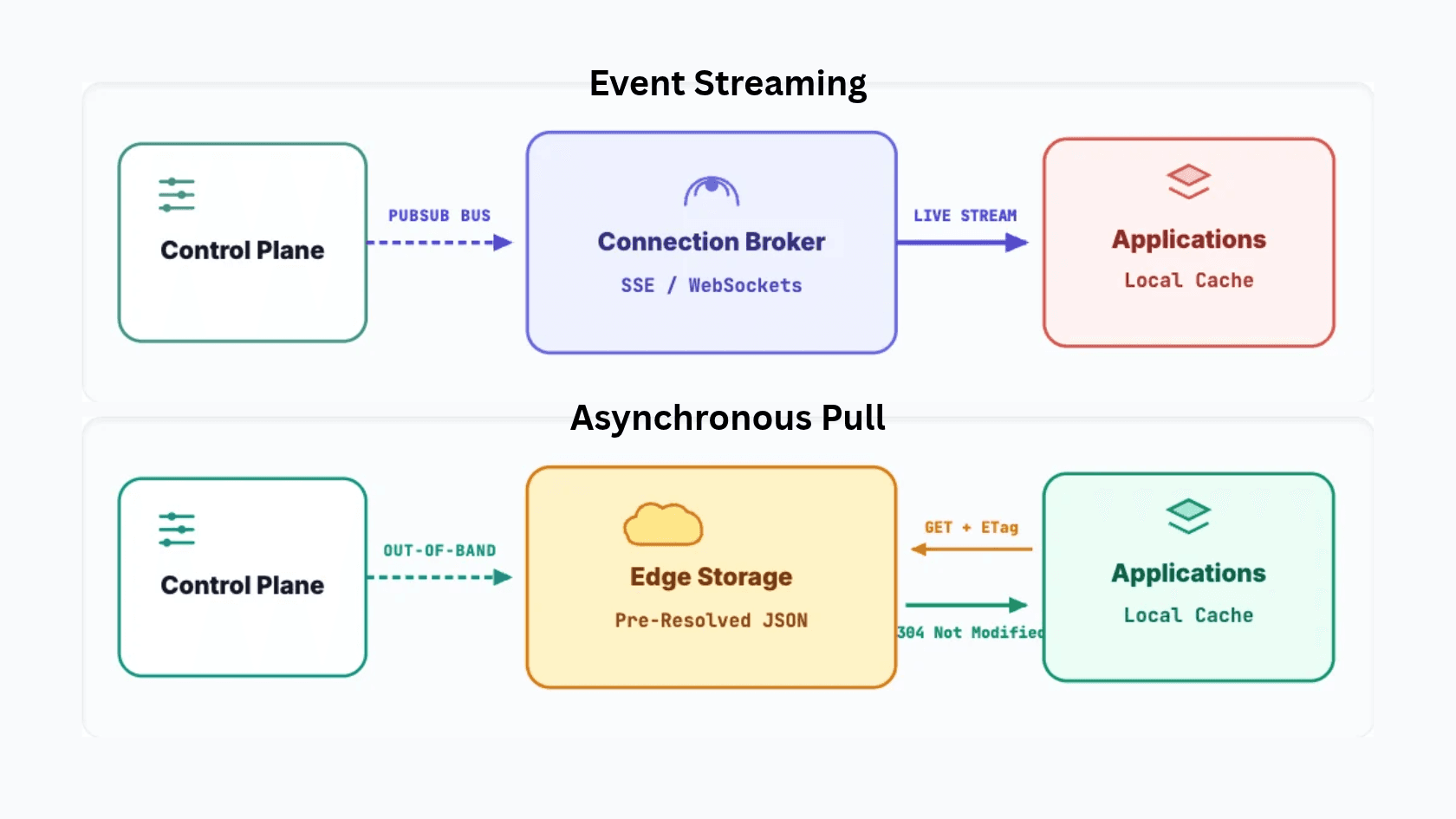
The following architectural diagram illustrates the topology difference between persistent push streams and edge-cached polling:
In the push model, ingress gateways manage active, long-lived connections for every client. In the polling model, client traffic terminates against edge caches, decoupling origin infrastructure load from client concurrency.
How Do WebSockets, SSE, and Edge Polling Compare Across 8 Critical Dimensions?
Selecting a distribution protocol requires analyzing trade-offs across operational resilience, network constraints, and resource consumption.
The following architectural decision matrix compares WebSockets, Server-Sent Events, and Edge-Cached Background Polling across eight core engineering dimensions:
| Engineering Dimension | WebSockets (WS) | Server-Sent Events (SSE) | Edge-Cached Background Polling |
|---|---|---|---|
| Connection Statefulness | Stateful bidirectional TCP/TLS socket. | Stateful unidirectional HTTP stream. | Stateless application-level request; may reuse persistent HTTP/2 or HTTP/3 connections. |
| Origin Resource Footprint | O(N) open sockets, kernel buffers, and descriptors. | O(N) open file descriptors and gateway sessions. | Largely independent of client concurrency; bounded by edge cache topology, TTL, and revalidation. |
| Edge Cacheability | Non-cacheable: bypasses CDN edge caching layers. | Open-ended stream: cannot be cached as a static object. | High edge cacheability: finite snapshot representations served and revalidated from CDN edge PoPs. |
| Middlebox Traversal | Often blocked or terminated by enterprise proxies. | Handled over HTTPS, but subject to silent proxy timeouts. | Standard HTTPS request with broad proxy and middlebox compatibility. |
| Reconnection Dynamics | Requires auth re-handshake and subscription recovery. | Auto-reconnects, but creates thundering herds at scale. | Independent, jittered polls: reduces synchronized recovery spikes. |
| Mobile Resource Profile | Keep-alive ping frames prevent mobile radio sleep. | Open stream requires periodic keep-alive comments. | Infrequent background requests avoid maintaining an active socket; mobile OS execution policies dictate radio wakeups. |
| Peacetime Wire Overhead | Periodic TCP keep-alive ping/pong frames. | Periodic newline or comment keep-alive frames. | Low: cache hits avoid origin transfer; conditional revalidation can reduce unchanged responses to header-only 304 responses. |
| Propagation Latency | Sub-second across open sockets. | Sub-second across open streams. | Bounded by polling cadence and cache revalidation policy. |
The Nature of Socket Resource Consumption
The resource footprint of persistent connections is an inherent consequence of stateful connection management.
As documented in the Linux TCP kernel specification, every open TCP socket allocates kernel memory buffers for receiving and transmitting data (net.ipv4.tcp_rmem and net.ipv4.tcp_wmem), alongside kernel socket structures (struct sock). Terminating TLS requires user-space framing buffers within reverse proxies such as Envoy and NGINX.
While dynamic autotuning (tcp_moderate_rcvbuf) adjusts buffer occupancy based on active throughput, maintaining hundreds of thousands of concurrent open TLS connections introduces a substantial memory baseline and turns active connection count into a primary infrastructure scaling vector.
Edge-cached polling avoids this connection-state scaling dimension at the origin. Connection state is ephemeral and terminated at edge PoPs, while origin load depends on cache invalidation and revalidation policy rather than client concurrency.
What Happens During Major Incidents and Network Partitions?
Architectures that perform well in steady-state peacetime can degrade unpredictably under wartime stress. When production incidents occur, infrastructure failures trigger network partitions, availability zone brownouts, and route flaps.
Examining how stateful push mechanisms react during operational disruptions reveals four structural failure modes.
1. Connection Stampedes (Thundering Herds)
When an availability zone degrades, a cloud gateway restarts, or a mobile cell tower hands off traffic, thousands of persistent SSE or WebSocket connections terminate simultaneously. When network connectivity restores, those disconnected runtimes attempt to reconnect immediately.
This wave of concurrent reconnects creates a severe connection stampede.
What is a Connection Stampede (Thundering Herd)?
A Connection Stampede (Thundering Herd) is a distributed systems failure mode where thousands of disconnected client runtimes simultaneously initiate network connections, TLS handshakes, and authentication requests against origin infrastructure following an outage or network partition. Without client-side jitter and aggressive rate limiting, the resulting traffic surge overwhelms connection brokers, CPU queues, and authentication databases, causing secondary cascading outages.
In managed cloud environments, connection establishment is strictly rate-limited. In Amazon API Gateway WebSocket quotas, new connections are subject to a default quota of 500 per second per account across all WebSocket APIs in a Region (which can be increased upon request).
At this default quota, reconnecting 100,000 clients in a single second represents 200 seconds of connection-establishment capacity at that sustained default rate, before accounting for retries or connection duration limits. During sudden cloud brownouts where thousands of clients disconnect simultaneously, uncoordinated reconnect waves easily exceed default gateway establishment quotas, triggering cascading HTTP 429 Too Many Requests throttles.
As Marc Brooker explains in the AWS Builders' Library whitepaper on timeouts, retries, and jitter, when systems fail under contention, retrying without randomized jitter synchronizes client requests into recurring waves of overload.
2. File Descriptor Exhaustion and Socket Memory Pressure
During mass reconnection events, ingress gateways experience elevated CPU load driven by TLS 1.3 cryptographic handshakes. As incoming connections queue up, operating systems approach file descriptor limits (EMFILE: too many open files). Gateway processes that exhaust available file descriptors cannot accept new TCP sockets, preventing clients from receiving critical incident updates. Simultaneously, kernel memory pressure increases across the connection pool.
3. Middlebox Silent Drops (Zombie Sockets)
Persistent connections must traverse enterprise firewalls, carrier-grade NATs (CGNAT), and mobile telecommunications gateways. These intermediate middleboxes aggressively track connection tables.
To reclaim resources, middleboxes may expire idle TCP state from their routing tables without cleanly notifying either endpoint. The client application believes its SSE stream remains open, while the server believes the client is connected. The socket becomes a half-open "zombie connection." While applications often implement heartbeat comments in SSE to detect dead TCP streams, silent middlebox disconnects introduce dead time before detection, leaving clients blind to urgent operational transitions.
4. Stream Reconciliation vs. Snapshot Convergence
Server-Sent Events deliver an ordered stream of application-defined events. When those events represent sequential deltas, a reconnecting client must either reconcile missed entries or fall back to a full snapshot fetch.
Operational state consumers care about the latest authoritative snapshot, not the historical sequence of intermediate state transitions. While an SSE design can be implemented to emit a fresh snapshot upon reconnection rather than replaying historical logs, any streaming design that relies on event resumption via Last-Event-ID must either retain enough event history in server memory to reconstruct missed transitions or implement a separate snapshot fallback path. For operational state, distributing pre-resolved snapshot artifacts eliminates this duality entirely.
The following comparison illustrates gateway resource behavior during steady-state versus wartime reconnection events:
| Failure Characteristic | Server-Sent Events / WebSockets | Edge-Cached Background Polling |
|---|---|---|
| Reconnection Traffic Profile | Sudden spike of TLS handshakes and auth checks | Uniform, randomized polling distribution |
| Gateway CPU Utilization | Spikes during TLS handshake storms | Flat: requests served directly by edge CDN caches |
| Origin Rate-Limit Impact | Vulnerable to gateway connection throttling under mass reconnects | Protected: origin sees requests filtered by cache policies |
| Zombie Connection Risk | Present: silent middlebox NAT drops delay state updates until heartbeat timeout | Negligible: no long-lived application-level connection state to detect and recover |
| Recovery Mechanism | Reconnect stream with delta replay or fallback snapshot | Client fetches current authoritative state snapshot directly |
Edge-cached polling avoids the connection-reestablishment storms associated with persistent streams. Client runtimes poll on uncoordinated, jittered intervals against edge caches, reducing synchronized traffic spikes.
How Do RFC 9110 and RFC 5861 Enable Origin-Shielded Edge Polling?
Background polling is often criticized as inefficient because critics assume clients download redundant payloads on every request. Modern HTTP standards, however, provide robust mechanisms for caching, revalidation, and background content refresh.
A common misconception is that edge polling simply means "Client asks CDN, CDN returns 304." In reality, an origin-shielded distribution architecture combines three distinct HTTP mechanisms:
- Caching: Serving a fresh representation from the edge cache without contacting the origin. A CDN can satisfy client requests directly and return
HTTP 200 OKwith the cached body throughout the artifact's cache lifetime. - Conditional Revalidation (RFC 9110): Using
ETagandIf-None-Matchso that when a client or edge cache revalidates, unchanged representations do not require re-transferring the payload body. If the validator matches, the server returnsHTTP 304 Not Modified. When an origin returns304to a CDN during origin revalidation, the CDN can update its cache headers and still return a cached200 OKto a client that did not send conditional headers, or return304directly to a client that did. - Stale Serving (RFC 5861): Permitting the edge cache to serve an existing (stale) representation immediately while asynchronously refreshing from the origin in the background (
stale-while-revalidate), or serving stale content if the origin is impaired (stale-if-error).
1. RFC 9110 Section 15.4.5: HTTP 304 Not Modified
Under RFC 9110 Section 15.4.5, the HTTP 304 (Not Modified) status code indicates that a conditional GET request evaluated to false. The server or edge cache informs the client that its stored representation remains valid, redirecting the client to use its local cache.
Crucially, RFC 9110 mandates that an HTTP 304 response cannot contain a message body:
"A 304 response is terminated by the end of the header section; it cannot contain content or trailers."
Because the response carries only HTTP headers (Date, ETag, Cache-Control) without a message body, it dramatically reduces wire bandwidth compared to re-downloading the entire state payload.
2. RFC 9110 Section 13.2.2: Precedence of Preconditions
RFC 9110 Section 13.2.2 defines the exact precedence order that caches and origin servers must follow when evaluating conditional headers. Step 3 mandates that when an If-None-Match header is present:
"When If-None-Match is present, evaluate the If-None-Match precondition... if false for GET/HEAD, respond 304 (Not Modified)."
Only if If-None-Match is absent does the server evaluate If-Modified-Since. By supplying an entity tag (ETag) representing the identity of the resolved state artifact (such as state-8f1a), client runtimes ensure representation identity without relying on synchronized modification timestamps across distributed servers.
3. RFC 5861: Asynchronous Stale Content Extensions
RFC 5861 extends standard HTTP cache control with two directives designed for distributed resilience:
What is Stale-While-Revalidate (RFC 5861)?
Stale-While-Revalidate (RFC 5861) is an HTTP Cache-Control extension that allows edge caches to immediately serve an existing cached representation to a client while asynchronously refreshing that representation from the origin in the background. By decoupling client response delivery from origin revalidation latency, stale-while-revalidate shields origin systems from traffic spikes while providing fast cache delivery.
RFC 5861 provides two critical directives for operational resilience:
stale-while-revalidate=<seconds>(Section 3): Enables the edge CDN to serve a cached state artifact immediately to the client while dispatching an asynchronous background request to origin to revalidate. Requests served under the stale-while-revalidate policy do not block on origin revalidation. However, if the SWR window expires before a successful revalidation occurs, subsequent requests will block normally.stale-if-error=<seconds>(Section 4): Enables edge caches to continue serving the last known good state artifact if the origin control plane is temporarily unreachable, experiencing network partitions, or returning HTTP 5xx errors.
These directives are supported by major CDN platforms, although configuration semantics and header handling vary by provider.
Three Operational Paths: Cache Hits, Conditional Revalidation, and Stale Serving
Depending on client cache headers and edge cache state, client polling requests take one of three distinct paths. In production, client SDKs and monitoring tools query the edge distribution plane directly via the canonical endpoint format (curl -X GET https://edge.theruntimehq.com/v1/rt_test_019efea9d16f79d1a874acea1142801a.json):
Case A: Fresh Edge Cache Hit (No Origin Contact)
A client polling without conditional headers (or during initial startup) hits an edge node holding a fresh representation. The client sends a standard GET request:
GET /v1/rt_test_019efea9d16f79d1a874acea1142801a.json HTTP/2
Host: edge.theruntimehq.com
The CDN serves the cached JSON snapshot immediately from edge memory with an HTTP 200 status code:
HTTP/2 200 OK
Date: Sat, 07 Nov 2026 12:00:05 GMT
Content-Type: application/json; charset=utf-8
ETag: "state-8f1a"
Cache-Control: public, max-age=15, stale-while-revalidate=60, stale-if-error=86400
X-Cache: HIT

{
  "runtimeState": {
    "applicationId": "app_019efea9-d16f-79d1-a874-acea1142801a",
    "state": "RUNTIME_STATE_OPERATIONAL",
    "message": "All systems operational",
    "capabilityStates": [
      {
        "capabilityName": "payments.card_processing",
        "state": "RUNTIME_STATE_OPERATIONAL",
        "message": "Credit card processing operational"
      }
    ],
    "updatedAt": "2026-11-07T12:00:00.000Z",
    "version": "14"
  }
}
Case B: Client Conditional Revalidation (Zero Body Payload)
A client SDK that already holds state snapshot "state-8f1a" in memory periodically re-checks the edge, sending an If-None-Match header:
GET /v1/rt_test_019efea9d16f79d1a874acea1142801a.json HTTP/2
Host: edge.theruntimehq.com
If-None-Match: "state-8f1a"
If the state has not transitioned, the CDN evaluates the precondition via RFC 9110 Section 13.2.2 and returns an HTTP 304 response without transferring the message body:
HTTP/2 304 Not Modified
Date: Sat, 07 Nov 2026 12:00:10 GMT
ETag: "state-8f1a"
Cache-Control: public, max-age=15, stale-while-revalidate=60
Case C: Asynchronous Stale Serving (SWR in Action)
When the edge cache's max-age expires (e.g., at second 16), the edge representation becomes stale. Under RFC 5861 stale-while-revalidate=60, the CDN immediately serves the stale representation to the client without blocking:
HTTP/2 200 OK
Date: Sat, 07 Nov 2026 12:00:16 GMT
Content-Type: application/json; charset=utf-8
ETag: "state-8f1a"
Cache-Control: public, max-age=15, stale-while-revalidate=60
X-Cache: STALE

{
  "runtimeState": {
    "applicationId": "app_019efea9-d16f-79d1-a874-acea1142801a",
    "state": "RUNTIME_STATE_OPERATIONAL",
    "message": "All systems operational",
    "version": "14"
  }
}
Concurrently in the background, the edge CDN dispatches an asynchronous conditional revalidation to origin:
GET /v1/rt_test_019efea9d16f79d1a874acea1142801a.json HTTP/2
Host: origin.theruntimehq.com
If-None-Match: "state-8f1a"
If the operational state is unchanged, origin confirms with a body-less response, and the CDN refreshes its edge cache TTL without impacting client latency:
HTTP/2 304 Not Modified
Date: Sat, 07 Nov 2026 12:00:16 GMT
ETag: "state-8f1a"
Cache-Control: public, max-age=15, stale-while-revalidate=60
The Architectural Trade-Off: Freshness vs. Resilience
In operational state distribution, stale content is not an unalloyed benefit. It is an explicit engineering trade-off.
If an edge cache or client serves stale operational state:
- An outage may remain declared after the upstream service has fully recovered, unnecessarily restricting user traffic.
- A newly degraded capability may not be recognized immediately, allowing user requests to hit failing dependencies.
Staleness tolerance is therefore a capability-level architectural policy rather than an automatic virtue.
| Distribution Mechanism | Operational Benefit | Operational Trade-Off |
|---|---|---|
| Edge Caching | Shields origin from client concurrency | State propagation reflects cache invalidation and TTL |
| Short TTL (e.g., 5-15s) | Faster propagation of status changes | Higher revalidation volume to origin |
| Stale-While-Revalidate | Avoids blocking clients on origin revalidation | Clients may observe state from previous evaluation window |
| Stale-If-Error | Distribution survives complete origin control plane outage | Last-known state persists until origin recovers or cache purges |
| Background Polling | Stateless scaling without persistent socket management | Bounded propagation latency rather than push immediacy |
Designing an operational state distribution system requires separating six distinct timing parameters:
- Client Synchronization Cadence: How frequently client runtimes poll the edge network.
- Edge Freshness Policy (
max-age): How long an edge PoP considers the state artifact strictly fresh. - Maximum Tolerated State Age (
stale-while-revalidate): The window during which edge nodes may serve stale state while refreshing in the background. - Stale-on-Error Policy (
stale-if-error): The emergency window during which edge nodes may serve cached state if the origin control plane becomes unavailable. - Emergency Invalidation Policy: The mechanism for actively purging edge caches when immediate global propagation is required.
- Client Local-State Fallback Policy: How consuming SDKs handle capability evaluation when an application cannot refresh state within its permitted freshness window (e.g. cold-start fail-open rendering vs. holding failure-sensitive actions).
Why Should Application Runtimes Avoid Synchronous Health Checks in the Request Path?
Decoupling protocol distribution is only half of the reliability equation. The other half is ensuring that operational state inspection never delays user transactions.
Modern architectures enforce strict traffic path isolation (detailed in our architectural breakdown of why operational control planes should never sit in the request path):
- Operational State Distribution Path (Out-of-Band):
Control Plane -> State Resolution -> Edge CDN -> SDK Memory Store. - Application Request Path (Critical Path):
Client UI -> Application Ingress -> Services -> Databases.
Operational state is synchronized in the background into local SDK memory. When an end user clicks "Submit Payment" or navigates between pages, the application executes local in-memory evaluation synchronously from local cache without a network round trip. The application does not initiate an external network call to ask, "Is the payment gateway healthy?" while a user waits.
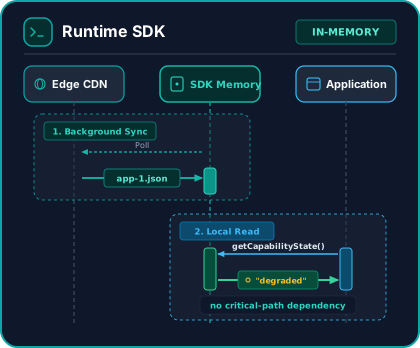 Figure 1: The runtime contract: SDK background polling updates local process memory out-of-band, allowing host applications to read capability state locally with zero critical-path network dependencies.
The difference in user experience between reactive request-path failures and proactive, memory-evaluated operational degradation is striking:
| Uncoordinated Reactive Failure (Generic Error) | Proactive Point-of-Need Graceful Degradation |
|---|---|
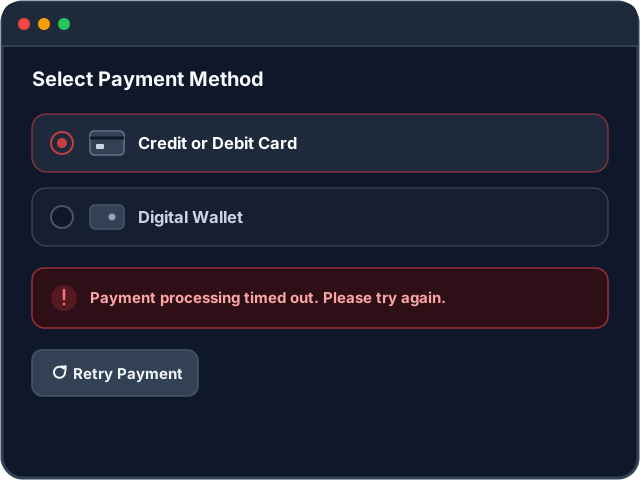 | 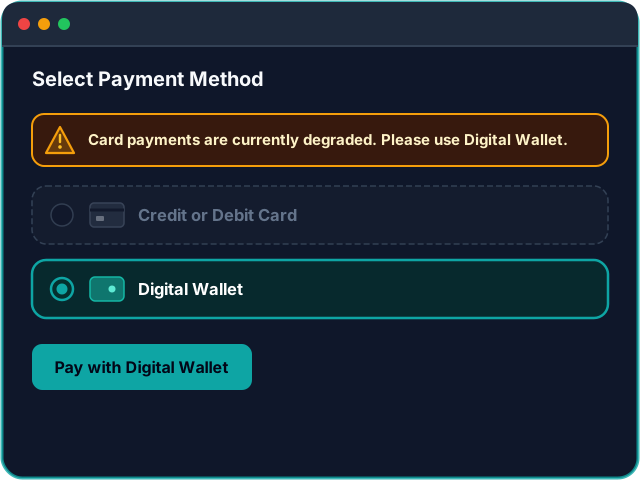 |
| Figure 2: Standard error response after synchronous request path failure. | Figure 3: Proactive adaptation evaluated synchronously from local memory. |
When systems lack operational state coordination, users fill out complex forms only to encounter generic error toasts after a backend timeout. With proactive operational state evaluation, the application adapts the interface before user submission, setting clear expectations and guiding traffic to healthy payment options.
Differentiating Degradation from Outages in Code
Client SDKs should differentiate UX behavior based on capability status, distinguishing between degraded performance and full outages.
The following TypeScript snippet illustrates consuming capability state using the RuntimeHQ React SDK (@theruntimehq/react):
import React from 'react';
import { useCapability } from '@theruntimehq/react';

interface PaymentSelectorProps {
  onSelectMethod: (method: 'credit_card' | 'apple_pay' | 'wire_transfer') => void;
}

export function PaymentSelector({ onSelectMethod }: PaymentSelectorProps) {
  // Evaluated synchronously from local SDK in-memory cache without a network round trip
  const { isDegraded, isOutage, message, loading } =
    useCapability('payments.credit_card');

  // In sensitive transactional flows, inspecting loading prevents submitting before initial sync
  if (loading) {
    return (
      <div className="rounded-lg border border-slate-700 bg-slate-900 p-4 text-sm text-slate-400">
        Checking payment system availability...
      </div>
    );
  }

  // 1. OUTAGE: Suspend card input entirely and direct users to alternative payment rails
  if (isOutage) {
    return (
      <div className="rounded-lg border border-rose-500/30 bg-rose-500/10 p-5 text-sm text-rose-200">
        <h4 className="font-semibold text-rose-100">Credit Card Processing Unavailable</h4>
        <p className="mt-1 text-xs text-rose-300/90">
          {message || 'Our primary payment gateway is experiencing an outage. Please choose an alternative below.'}
        </p>
        <div className="mt-4 flex gap-3">
          <button
            onClick={() => onSelectMethod('apple_pay')}
            className="rounded bg-rose-600 px-4 py-2 text-xs font-semibold text-white hover:bg-rose-500"
          >
            Pay with Apple Pay
          </button>
          <button
            onClick={() => onSelectMethod('wire_transfer')}
            className="rounded border border-rose-400/30 px-4 py-2 text-xs font-semibold text-rose-200 hover:bg-rose-500/10"
          >
            Direct Wire Transfer
          </button>
        </div>
      </div>
    );
  }

  // 2. DEGRADED: Maintain card input but display an advisory notice and fallback options
  if (isDegraded) {
    return (
      <div className="rounded-lg border border-amber-500/30 bg-amber-500/10 p-4 text-sm text-amber-200">
        <div className="flex items-center justify-between">
          <span className="font-medium">Card Processing Delayed</span>
          <span className="text-xs text-amber-300/80">Elevated Processing Times</span>
        </div>
        <p className="mt-1 text-xs text-amber-300/90">
          {message || 'Transactions are processing with elevated latency. For faster confirmation, consider digital wallets.'}
        </p>
        <div className="mt-3 flex gap-2">
          <button
            onClick={() => onSelectMethod('credit_card')}
            className="rounded bg-amber-600 px-3 py-1.5 text-xs font-semibold text-white hover:bg-amber-500"
          >
            Continue with Card
          </button>
          <button
            onClick={() => onSelectMethod('apple_pay')}
            className="rounded border border-amber-400/30 px-3 py-1.5 text-xs font-semibold text-amber-200 hover:bg-amber-500/10"
          >
            Switch to Apple Pay
          </button>
        </div>
      </div>
    );
  }

  // 3. OPERATIONAL: Standard execution path
  return (
    <div className="space-y-3">
      <button
        onClick={() => onSelectMethod('credit_card')}
        className="w-full rounded-lg bg-indigo-600 px-4 py-3 text-sm font-semibold text-white hover:bg-indigo-500"
      >
        Pay with Credit Card
      </button>
    </div>
  );
}
Client UI Gating vs. Authoritative Backend Enforcement
While client UI adaptation significantly improves user experience, client-side gating must not be confused with backend transaction safety:
- Client Presentation Guidance: Inspecting
isDegradedorisOutagein the browser reduces avoidable submissions from that specific interface, preventing users from submitting forms doomed to fail. - Backend Transaction Enforcement: Backend services, API gateways, and asynchronous workers must independently evaluate capability state to enforce idempotency, reject or queue transactions safely, and protect core databases.
- SDK Pre-Sync Defaults: The SDK's default cold-start representation is fail-open for UI rendering (
isDegraded: false,isOutage: false,loading: true) to avoid blocking application rendering if initial network synchronization is interrupted. Applications executing failure-sensitive actions can inspectloadingto defer those actions until synchronization completes.
How Does an Operational State Control Plane Govern State Distribution?
Distributing operational state reliably requires a dedicated architectural platform that separates operational intent from application delivery lifecycles.
Application Code vs. Operational State
Application code deployments involve CI/CD pipelines, container builds, automated testing, and canary rollouts. These safety mechanisms take 15 to 45 minutes to execute.
Operational state represents the live condition of system capabilities. When an upstream dependency fails, incident responders need deterministic governance that can propagate across web storefronts, mobile apps, and backend services without deploying new code. Unlike feature flag platforms built for code rollouts and user experimentation (where flags typically control which users or cohorts receive a code path or configuration; examined in our comparison of capability targeting vs. feature delivery), an Operational State Control Plane communicates the live condition of system capabilities during operational events, leaving application policies to determine runtime behavior.
What is an Operational State Control Plane?
An Operational State Control Plane (OSCP) is a centralized architectural layer for declaring, resolving, and distributing machine-readable Operational State across connected applications and capabilities during outages, degraded service, and maintenance events. Designed to operate independently of application deployment pipelines and outside the critical request path.
An Operational State Control Plane enforces a fundamental principle: centralize operational intent, decentralize application behavior. The control plane deterministically resolves declared operational conditions, scopes, and precedence rules into an effective state for each capability, while individual applications determine how to adapt their UI and business logic.
The complete operational state lifecycle (defined in the RuntimeHQ architecture overview) follows five sequential phases:
- Declare: Incident commanders or site reliability engineers declare an operational condition following verified runbook workflows (or automated triggers explicitly confirmed through incident management policies).
- Resolve: The centralized Operational State Engine evaluates all concurrent declarations, overrides, and capability scopes, deterministically resolving a single effective state artifact (a process teams often attempt manually when building an in-house operational state engine).
- Distribute: RuntimeHQ's distribution layer publishes the resolved JSON state artifact out-of-band to global edge CDN PoPs, configured with RFC 5861
stale-while-revalidateand RFC 9110ETagheaders. - Cache: Client and backend SDKs background-synchronize state via conditional HTTP requests, storing the resolved capability state in local memory.
- Decide Behavior: Consuming applications query local SDK memory synchronously to adjust presentation, disable impaired buttons, or offer fallback workflows.
The following flowchart illustrates the end-to-end lifecycle:
By separating state resolution from runtime execution, the system achieves global operational coordination without introducing synchronous dependencies into the critical request path.
What Are the Core Architectural Principles for Operational State Distribution?
When building or evaluating operational state infrastructure, adhere to five core system design principles:
- Align Protocol Statefulness with Workload Dynamics: Use stateful push protocols for high-frequency bidirectional event streams. Use stateless, edge-cached background polling for high-read, low-write operational state distribution.
- Make Origin Load Largely Independent of Client Concurrency: Leverage edge CDN caching, conditional validation, and stale-serving directives so that origin traffic is bounded primarily by cache topology and revalidation frequency rather than client connection volume.
- Enforce RFC 9110 Precondition Order to Minimize Wire Bandwidth: Combine entity tags (
ETag) withIf-None-Matchto serve body-less HTTP 304 Not Modified responses, compressing steady-state conditional validation to minimal header bytes. - Remove State Checks from the Application Request Path: Never block user transactions on synchronous network calls to external control planes. Evaluate operational state locally from memory without adding network latency.
- Centralize Operational Intent While Decentralizing Runtime Execution: Centralize capability status authority in the control plane while allowing individual applications to retain ownership of user experience adaptation.
RuntimeHQ was designed around these principles.
How Do You Choose Between Persistent Push Streams and Edge-Cached Polling?
To determine whether your architecture requires persistent push streams or edge-cached polling, apply the following diagnostic evaluation:
When Do You Need This?
You should adopt edge-cached background polling via an Operational State Control Plane if:
- Low Operational State Mutation Velocity: State transitions occur sparsely (minutes, hours, or days apart), while state evaluations occur on every user interaction, making read-to-write asymmetry extreme.
- Fleet-Wide Client Concurrency: Your architecture serves tens of thousands of concurrent client sessions across web storefronts, mobile apps, or backend microservices.
- Vulnerability to Reconnection Storms: A network partition or cloud provider brownout could trigger connection stampedes that overwhelm your API gateway rate limits.
- Failure-Sensitive Transactional Flows: Your application processes revenue-critical or high-consequence transactions (checkout, funds transfers, bookings, inventory reservations) where unhandled errors destroy customer trust.
- Deployment Pipeline Latency: Your standard CI/CD deployment pipeline requires more than 10 minutes to roll out an emergency banner or disable a failing code path.
- Multi-Surface Coordination: An operational incident requires synchronized graceful degradation across multiple applications (e.g., web app, iOS app, Android app, and partner APIs).
When Does Edge-Cached Polling NOT Apply?
Edge-cached background polling is not appropriate for all workloads. Simpler alternatives or persistent push protocols are generally better suited when:
- Monolithic Single-Application Deployments: Early-stage architectures with a single monolithic frontend and backend, where a simple static maintenance page or local configuration handling is often sufficient until multi-surface or multi-service operational coordination is required.
- Sub-Second Reactive Latency is Mandatory: Workloads such as multiplayer gaming physics, collaborative whiteboard cursor synchronization, or high-frequency trading where latency must remain under 100 milliseconds.
- Continuous Bidirectional Communication: Applications requiring frequent client-to-server data transmission over the same connection, such as customer support chat or audio streaming.
- Strict Sequential Event Log Replay: Systems where clients must process every intermediate state transition in strict historical sequence via
Last-Event-IDrather than converging on the latest resolved state snapshot. - Low Concurrency Internal Tools: Small-scale internal dashboards with dozens of users where managing persistent socket memory overhead is economically negligible.
Conclusion: Matching Protocol Architecture to Operational Reality
Protocol selection in distributed systems is about matching communication characteristics to workload physics.
While Server-Sent Events and WebSockets represent proven choices for high-frequency, bidirectional application data, repurposing them for broadcast operational state introduces unnecessary statefulness, memory consumption, and reconnection stampede vulnerabilities.
Operational state is fundamentally a snapshot-convergence workload. Once that distinction is recognized, an edge-cached polling architecture backed by RFC 9110 conditional validation and RFC 5861 stale-serving directives becomes a natural fit. It separates client concurrency from origin connection state and allows freshness to be traded explicitly against resilience. Applications evaluate operational conditions locally from memory without a network round trip, shielding users from uncoordinated failures without adding network latency to the critical request path.
RuntimeHQ implements this architectural model as an Operational State Control Plane, giving platform teams centralized operational control while keeping client and backend runtimes fully decoupled.
Key Takeaways
- Workload Symmetry Dictates Protocol Design: Application data streaming requires low latency push; operational state distribution requires origin-shielded edge fanout with origin load decoupled from client concurrency.
- Reconnection Storms Threaten Push Gateways: When infrastructure degrades, thousands of dropping persistent sockets trigger connection stampedes that breach gateway rate limits and exhaust connection resources.
- HTTP Standards Shield Origins: Combining RFC 9110 Section 15.4.5 (304 Not Modified) with RFC 5861 (stale-while-revalidate and stale-if-error) allows edge CDNs to serve client polls while bounding origin traffic by cache topology and revalidation frequency.
- Keep the Request Path Out-of-Band: Operational state must be synchronized in the background and evaluated synchronously from local memory to avoid blocking user transactions.
To discuss your current operational-state architecture and explore how an Operational State Control Plane decouples degradation from application delivery, reach out to our engineering team or explore the RuntimeHQ SDK Documentation.
Book a Walkthrough
Discuss your architecture and integration directly with the engineers building RuntimeHQ. No sales reps or qualification decks.
Pick a Time