Primary-source architectural retrospectives of major cloud, identity, payment, and SaaS outages. Every report separates verified provider disclosures from downstream systems lessons on capability-scoped graceful degradation.
5 Analyzed Postmortems·5 Failure Patterns·Latest Incident: Nov 17, 2026
Incident Timeline (UTC)
Recent Cloud & SaaS Disruptions
Verified incident durations plotted chronologically. Bar length reflects core verified service disruption minutes; select any failure pattern below to filter the index.
Bar colors indicate core verified duration bands: under 6h (teal), 6h to 12h (amber), 12h and over (coral).All dates normalized to UTC
Filter by Architectural Failure Pattern or Capability
Showing 5 of 5 postmortems
Failure Pattern
Affected Capability Layer
Comparative Index
At-a-Glance Outage Comparison Matrix
A structured summary mapping each upstream outage to its client-side operational gap and primary vendor status disclosure.
Comparative index of analyzed cloud and SaaS outage postmortems with UTC dates, verified durations, failure patterns, client operational gaps, and primary sources.
Provider
Incident Date (UTC)
Verified Duration
Failure Pattern
Client-Side Operational Gap
Primary Source
Postmortem
Apple Services
Nov 17, 2026
~3h 40m (82m status lag)
Federated Rail Asymmetry
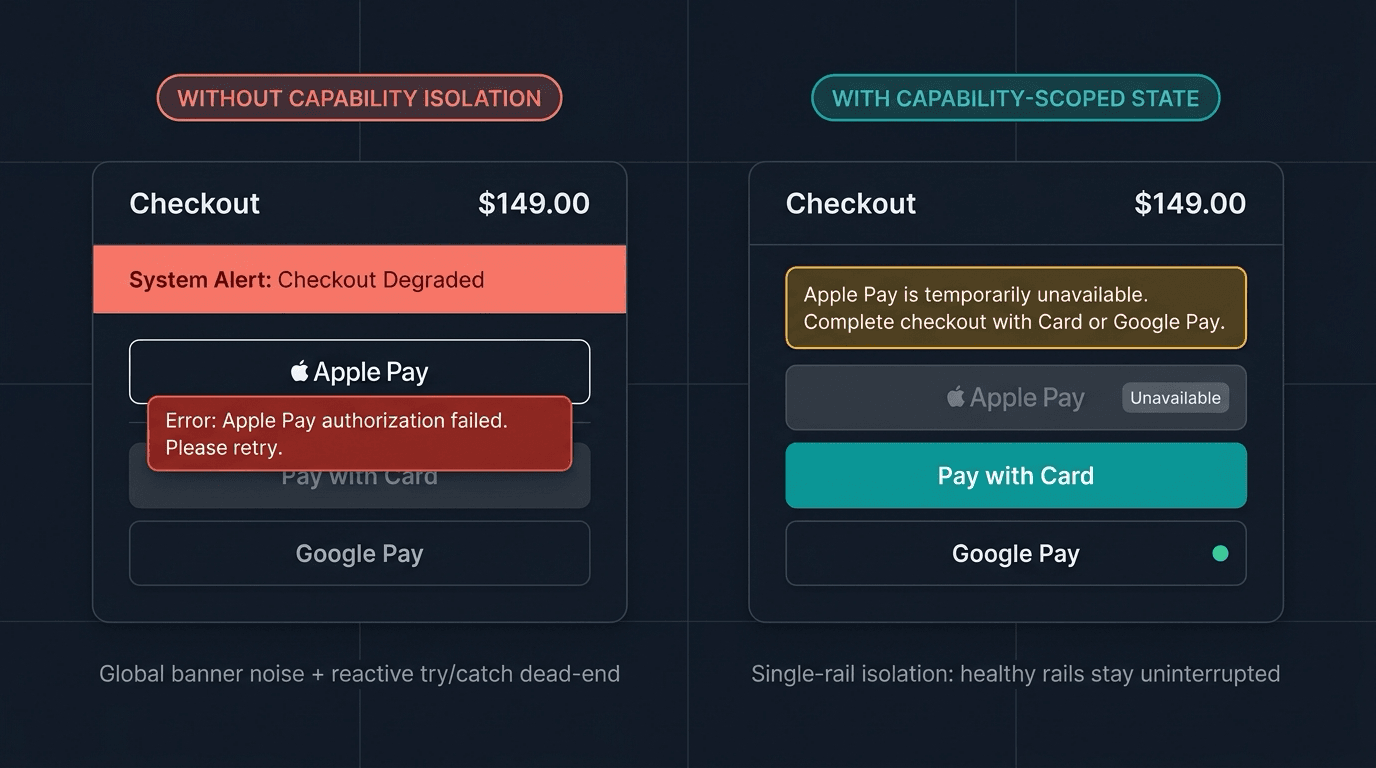
Apple Pay and Sign in with Apple degraded alongside operational card and Google rails while official status acknowledgement lagged by 82 to 88 minutes.
Tenant-bound Exchange and Graph dependencies prevented transparent multi-cloud failover, prolonging impairment inside downstream AI connectors and public portals.
A single-zone power loss in europe-west2-b spilled into surviving London zones via failover compute surges and synchronous cross-zone control-plane timeouts.
Each teardown walks through the verified UTC timeline, analyzes why standard workarounds stalled, and includes concrete runtime degradation schemas and code patterns.
Apple Services · Nov 17, 2026~3h 40m (82m status lag)
Apple Pay and Sign in with Apple degraded alongside operational card and Google rails while official status acknowledgement lagged by 82 to 88 minutes.
Tenant-bound Exchange and Graph dependencies prevented transparent multi-cloud failover, prolonging impairment inside downstream AI connectors and public portals.
A single-zone power loss in europe-west2-b spilled into surviving London zones via failover compute surges and synchronous cross-zone control-plane timeouts.
These retrospectives are written for Staff Engineers, SREs, and Platform Architects evaluating real-world dependency failure modes, not as vendor commentary.
01
Primary Vendor Disclosures First
Every postmortem anchors its timeline to official provider status pages, Post-Incident Reviews (PIRs), and primary downstream incident reports. Secondary media coverage is used strictly for corroboration.
02
UTC Normalization & Four-Point Timelines
All timestamps are normalized to UTC and distinguish initial disruption, official vendor acknowledgement, primary customer recovery, and final closure so acknowledgement lag and recovery tails stay visible.
03
Explicit Separation of Facts & Architecture
Provider-reported root causes are separated from architectural interpretation. Our focus is the downstream client operational gap, never criticizing the upstream engineering teams managing complex failures.
Resilience Boundaries
Frequently Asked Questions on Outage Resilience
Common architectural questions on separating upstream infrastructure recovery from downstream customer-facing application behavior.
How does a RuntimeHQ outage postmortem differ from a vendor Post-Incident Review (PIR)?
A vendor PIR explains the upstream infrastructure or software root cause inside the provider's own systems. Our architectural retrospectives examine the downstream boundary: what happens inside customer-facing web apps, mobile clients, and backend integrations while an upstream dependency is degraded, and which graceful degradation patterns isolate the blast radius.
Why does multi-zone or multi-region cloud redundancy not eliminate the operational gap?
Infrastructure redundancy protects compute and storage availability, but cross-zone failover surges, synchronous control-plane timeouts, and tenant-bound data gravity still surface errors to client applications. Even when backend infrastructure recovers automatically, clients need out-of-band, machine-readable operational state to guide user journeys during the impaired window.
When should an application use capability-scoped degradation instead of a global outage banner?
A global banner fits whole-application outages or scheduled maintenance affecting all users. When an upstream outage impacts a single capability, such as Apple Pay checkout authorization or an Exchange email connector, capability-scoped operational state allows the application to degrade only that workflow while keeping parallel or unaffected journeys running normally.
Why can relying solely on an upstream vendor's status page delay client response?
Public status pages are authored for broad external transparency and often exhibit acknowledgement lag while providers verify scope across tenants. In the November 2026 Apple Services incident, downstream Stripe and Anthropic status logs recorded elevated errors 82 to 88 minutes before Apple's first System Status posting. Decoupled operational state lets your own team declare capability conditions based on your live telemetry.
Does an Operational State Control Plane prevent upstream cloud or SaaS outages?
No. An Operational State Control Plane does not prevent upstream provider failures, fix internal code bugs, or replace standard error handling and circuit breakers. It provides an out-of-band declaration and edge distribution layer so web, mobile, and backend surfaces coordinate predictable degraded behavior while upstream recovery is underway.
Stress-Test Your Upstream Dependency Boundaries
Review your critical third-party dependencies, evaluate capability-scoped fallback patterns, and walk through the Operational State Control Plane contract with an engineer.